The workings of electricity are often introduced to students by way of a comparison to water, with voltage analogous to pressure, current to flow rate, wires to hoses, and so on. Even in more advanced contexts, it can be helpful—for building intuition, if nothing else—to think of electricity’s behavior in terms of fluid dynamics.
But how far can the analogy take us? Can we build circuits and logic gates and such things using actual fluids, rather than electricity? The short answer is, “Yes!” YouTuber and science educator Steve Mould made a water-powered computer several years ago, and long before that, a fascinating device known as the water integrator was being used in the Soviet Union to solve partial differential equations.
Of course, water isn’t the only fluid you can use in devices like this, and in practical terms, it comes with some pretty significant drawbacks. Its non-compressibility means that water hammer is a constant danger, and on a more mundane level, a leak will leave you with a wet floor and no computer, just like a gamer whose home-built water-cooling system has just cooked his 5090.
But fluid doesn’t have to be a liquid. You can also use a gas—and you can get some pretty impressive results, too, as evidenced by the latest installment in YouTuber Soiboi Soft’s ongoing quest to build all manner of air-powered devices. As his name suggests, our protagonist is interested in soft robotics—his first projects involved constructing robots made out of silicone, but his more recent work has taken him into the field of microfluidics.
This latest video finds him building a display out of hydraulic “pixels”, each of which can be inflated or deflated individually by a connected solenoid valve. The video starts with the construction of the basic elements of a single pixel: an open-faced shell and a soft silicone membrane that sits over that opening. Interestingly, it’s the absence of air that constitutes an “on” state. When the cell is inactive, the membrane sits flat. The pixel is activated by pulling a vacuum, which in turn sucks the silicone membrane back into the cell, creating a hemispherical depression.
Expanding beyond a pixel into multiple pixels requires some more complicated “wiring”. The pixels are laid out on a grid, with each row and column connected to its own vacuum pump. A pixel needs to activate only when both its row and column lines are active; this requires a simple AND gate, which in turn is constructed from two “vacuum transistors”. The layered construction is very much reminiscent of the construction of a silicon chip; this device could conceivably be called a “silicone chip”, making this another context in which it’s important to know the difference between the two.
By the end of the video, Soiboi has a 4×4 grid of silicone pixels working impressively well—he spells out “Hi world!”, displays some smiley faces, and speculates on the possibility of a hydraulic version of Snake. There’s something hypnotic about the whole spectacle, too: the soft clicking and hissing of the vacuum lines as they switch on and off, the way the silicone membranes are drawn sharply into their individual cells and then relax back to flatness as the vacuum is released, the soft German-accented narration… oh god, is this ASMR?
Trending Products
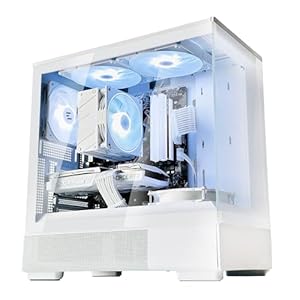
Zalman P10 Micro ATX Case, MATX PC Case with 120mm ARGB Fan Pre-Put in, Panoramic View Tempered Glass Entrance & Aspect Panel, USB Sort C and USB 3.0, White


Wireless Keyboard and Mouse, Ergonomic Keyboard Mouse – RGB Backlit, Rechargeable, Quiet, with Phone Holder, Wrist Rest, Lighted Mac Keyboard and Mouse Combo, for Mac, Windows, Laptop, PC

Nimo 15.6 FHD Pupil Laptop computer, 16GB RAM, 1TB SSD, Intel Pentium Quad-Core N100 (Beat to i3-1115G4, As much as 3.4GHz), Backlit Keyboard, Fingerprint, 2 Years Guarantee, 90 Days Return, WiFi 6, Win 11

Dell S2722DGM Curved Gaming Monitor – 27-inch QHD (2560 x 1440) 1500R Curved Display, 165Hz Refresh Rate (DisplayPort), HDMI/DisplayPort Connectivity, Height/Tilt Adjustability – Black
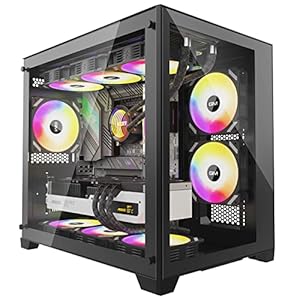
GIM Micro ATX PC Case with 2 Tempered Glass Panels Mini Tower Gaming PC Case Micro ATX Case with 2 Magnet Mud Filters, Gaming Pc Case with USB3.0 I/O Port, Black with out Followers